
August 22, 2026
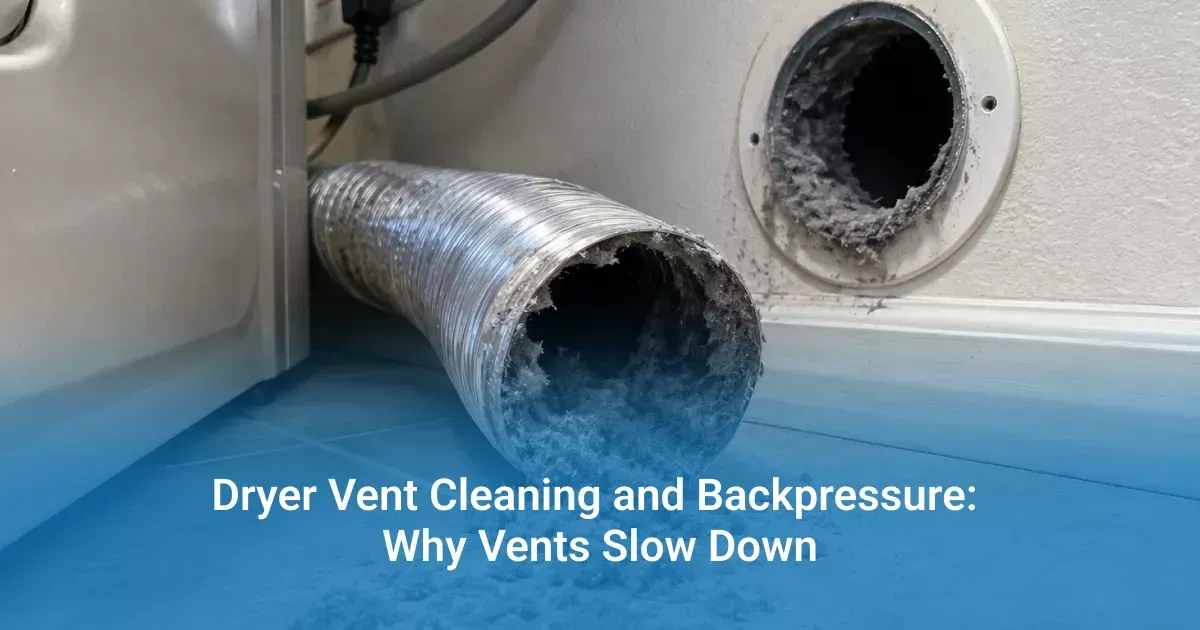
Dryer vent cleaning removes the lint that builds backpressure inside a long or bendy vent run. Every extra foot of duct and every 90-degree bend adds resistance that traps hot, damp air inside the dryer. A vent can pass code on install day and still choke on airflow once lint collects inside it.
Key Takeaways
- Dryer vent cleaning matters most on long or bendy runs, where lint builds backpressure faster than on a short, straight vent
- Building code allows a standard dryer vent up to 35 feet, but each 90-degree bend cuts that allowance by 1.5 to 5 feet
- Flexible plastic or foil ducting traps lint and kinks more easily than rigid metal duct, per the Consumer Product Safety Commission
- A vent that passed code when installed can still build dangerous backpressure once lint collects inside it
- A 2-minute airflow check at the outside vent hood tells you more than counting the months since your last cleaning
Why Vent Length Slows Down Drying
What Happens Inside a Long Duct
Every foot of the dryer vent duct adds a little friction. Hot, damp air has to push through that friction to escape outside. A short, straight vent lets that air out fast. A long vent slows it down. Heat and moisture stay trapped inside the drum longer, so the dryer has to run extra cycles to finish one load.
What a Longer Run Costs You Over Time
- Longer dry times, even with a clean vent and an empty lint trap
- Higher energy bills, since the dryer runs extra cycles to finish one load
- Extra wear on the dryer's heating element and motor from the added strain
- More duct surface area for lint to catch and build up on over time
Professional dryer vent cleaning clears the lint side of this problem, but it cannot shorten the duct or remove a bend. Length and bends set the ceiling on how fast air can move, no matter how clean the vent is.
Not Sure If Your Vent's Length Is Working Against You?
Our NADCA-certified technicians measure the full run and every bend before recommending a fix.
How Long Is Too Long? What Winchester and Harrisonburg Homes Run Into
The 35-Foot Code Limit
Laundry rooms in this area often sit in basements or interior rooms, far from an outside wall. That means a longer vent run than a laundry room built right next to an exterior wall. Under the International Residential Code, a standard 4-inch dryer vent tops out at 35 feet before you add any bends.
How Elbow Type Changes the Math
A smooth, wide-radius 90-degree elbow costs about 1.5 feet off the 35-foot allowance. A tight, mitered 90-degree elbow costs far more, up to 5 feet. A mitered elbow has sharp, angled corners, like a picture frame joint, while a wide-radius elbow curves gradually, more like a bent garden hose. The sharper the turn, the more it blocks airflow, so it counts against the limit more.
What This Looks Like in a Real Basement Layout
A basement laundry room with two mitered 90-degree turns already uses up 10 feet of the 35-foot allowance. That happens before the duct even crosses a single foot of open floor space. Add a third turn, or route the vent to the far side of the house. A code-compliant vent can then end up much closer to its limit than most homeowners realize. Our dryer vent cleaning service flags any run over 15 feet for six-month cleaning. That is well inside the 35-foot legal max, but it is the point where lint tends to build up faster.
Read More About:
7 Signs Your Dryer Vent Needs Cleaning in Winchester VA Homes
How Many Bends Is Too Many? Why Two Turns Can Matter More Than Ten Extra Feet
Why a Bend Blocks More Than Straight Duct
A 90-degree elbow does more than change direction. It also blocks airflow, the same way a kink in a garden hose slows down water. Two tight, mitered elbows can subtract a full 10 feet from the 35-foot allowance, the same penalty as adding 10 feet of straight pipe. Two smooth, wide-radius elbows cost far less, closer to 3 to 4 feet. Lint also collects fastest on the inside edge of every bend, where airflow slows down the most.
The Hidden Cost of Flexible Ducting
Flexible foil or plastic ducting makes every bend worse. The Consumer Product Safety Commission warns it traps lint more easily. It is also more prone to kinks and crushing than rigid metal duct. A vent with several tight turns and flexible material can restrict airflow more than a longer, straighter run in a rigid duct. This holds true even when the actual duct measures shorter.
Backpressure vs. a Simple Lint Clog: What Is the Difference?
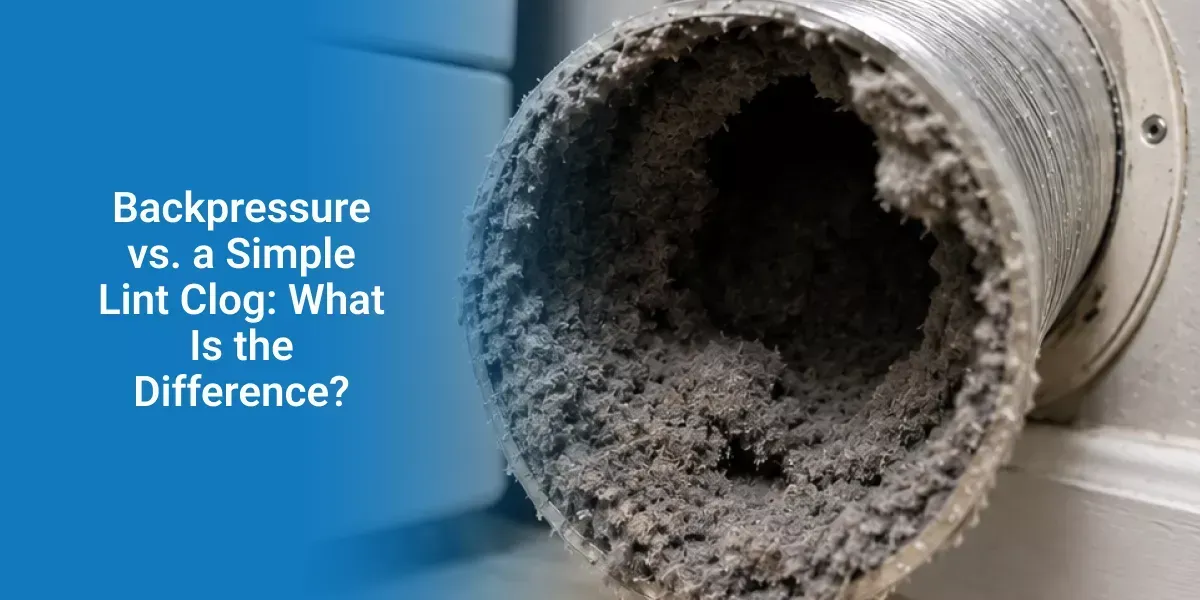
Backpressure is not the same thing as a clogged vent. Backpressure is the resistance that builds inside a dryer vent when exhaust air cannot escape as fast as the dryer pushes it out. It comes from three things working together, not lint alone.
What Causes Backpressure
Duct length is one factor, since every extra foot adds friction the exhaust fan has to push through. Bend count and tightness matter too, because sharper, more frequent turns block airflow more than lint by itself. Duct material and condition play a role as well, since kinked, crushed, or flexible foil duct restricts air even right after a cleaning.
Why a Fresh Cleaning Does Not Always Fix It
A little lint slows things down gradually, and a fresh cleaning usually fixes it. Backpressure from a long or bendy run is different. It can restrict airflow again shortly after a cleaning, because the length and turns themselves work against the exhaust fan, not just leftover lint. This is the gap that a routine vent cleaning service alone cannot close if the run itself is the problem.
Warning Signs Your Vent Has a Backpressure Problem
Watch for these signs together, not just one at a time:
- Clothes take two cycles or longer to dry, even for a small load
- The dryer feels hot to the touch on the outside during a cycle
- The laundry room feels noticeably warmer or more humid than usual
- The exterior vent hood flap barely opens, or stays propped open with visible lint
- You notice a faint burning or musty smell near the dryer or vent line
One sign alone does not always mean trouble. Two or more together are a strong signal. Check the vent's length, bends, and material before lint builds into a bigger risk.
Read More About:
Could a Clogged Dryer Vent Cost You Your Home Insurance Claim?
In Winchester or Harrisonburg?
Schedule a licensed inspection before backpressure turns into a bigger repair.
A 2-Minute Self-Check Before You Call Anyone
Anyone can run this check in about two minutes, no tools required:
- Start a load, then go outside and find the exterior vent hood
- Hold a hand near the vent opening and confirm air is moving out strongly, not just trickling
- Count the turns between the dryer and the exterior wall. Two or more 90-degree bends is a signal to check the length against the 35-foot code allowance
- Check the vent hood's flap. If it will not open fully, or stays propped open with lint, the run is already restricted
- If airflow feels weak, the vent has more than two bends, or the run looks close to 35 feet, call for a professional inspection instead of guessing
Conclusion
A dryer vent can pass a quick glance and still work against itself. Length, bend count, bend type, and duct material all add up. Two of those factors, length and bends, decide how hard your dryer has to work, no matter how clean the duct is. In Winchester and Harrisonburg, basement and interior laundry rooms often mean longer runs than a simple straight shot to an exterior wall.
Run the 2-minute check above before you assume a clean vent is a safe vent. If your home has not had a length and airflow check recently, give us a call or text at (540) 208-2628 for Harrisonburg or (540) 203-9019 for Winchester, or
request your free estimate online.
How long can a dryer vent be before it needs a booster fan?
Most dryer vents need a booster fan once the run passes 35 feet of equivalent length. Each 90-degree bend counts too, 5 feet for a tight, mitered elbow, or as little as 1.5 feet for a smooth, wide-radius one, per the International Residential Code. Several turns can trigger the need for a booster fan well before 35 feet.
Does every bend in a dryer vent affect airflow?
Yes, every bend affects airflow. Some bends matter far more than others. A gentle, wide-radius turn restricts far less than a tight, mitered 90-degree elbow. That is why code tables assign different length penalties to different elbow types. Two tight elbows can cost as much airflow as ten extra feet of straight duct, even though the vent looks shorter.
Can a short dryer vent still have airflow problems?
Yes, a short dryer vent can still have airflow problems. A crushed or kinked section of flexible ducting can choke airflow just as badly as extra length. The Consumer Product Safety Commission warns that flexible foil or plastic duct is more prone to kinks and crushing than rigid metal duct. Length is one variable. Duct material and installation quality matter just as much.
How do I know if my dryer vent's backpressure is too high?
High backpressure usually shows up as weak airflow at the exterior vent hood. Hold a hand near the outside vent while the dryer runs. Weak or barely-there airflow is one sign. A flap that will not open fully is another. Drying times that have crept up over several months are a third. All three mean the backpressure is too high for the duct to handle.
Should I switch to a rigid duct instead of a flexible dryer vent hose?
Yes, rigid or semi-rigid metal duct is the safer choice over flexible hose. The Consumer Product Safety Commission notes that most manufacturers specify rigid or semi-rigid metal ducts because it gives maximum airflow. Flexible plastic or foil hose traps lint more easily. It is also more prone to kinks and crushing. Switching removes one of the easiest ways backpressure builds up.
How often should a long dryer vent run be cleaned compared to a short run?
A long or bendy vent run should be cleaned every six months, not once a year. Longer runs and extra bends give lint more surface area to catch on. Buildup happens faster, even with identical laundry habits. A short, straight run to a nearby exterior wall can often stay on the standard annual schedule.